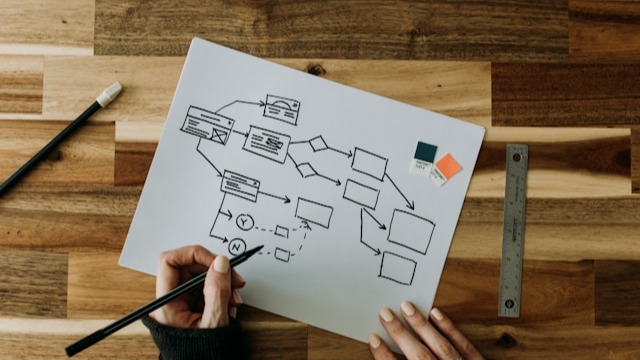
Value stream mapping (VSM), or lean value stream mapping, is a Lean tool that traces a process from start to finish. This way, you can visualize the flow and know where value is created—and where waits, rework, or friction appear.
Although it was created for Lean Manufacturing, today it’s also applied in services, software, remote teams, and freelance work. It’s useful whenever you need to organize a flow that goes from prospecting to producing, delivering, and getting paid.
That’s why this guide brings you everything from a clear definition and simple examples to the steps for creating a value stream map.
Value Stream Mapping (VSM): Definition, Benefits, and How to Apply It
What Is Value Stream Mapping (VSM)?
Value stream mapping (VSM) is a Lean tool that uses a flow diagram to show, from end to end, how a product or service is produced and delivered to the customer.
Beyond representing each step of the process, value stream mapping helps distinguish which activities add value and which generate waste. It also shows how information flows and, where applicable, how materials move between areas or teams.
The idea behind lean value stream mapping is to view the complete process holistically to detect bottlenecks and idle time. With that clarity, you document the current state and design a more efficient future process.
What Is Value Stream Mapping Used For in Lean?
In Lean, the value stream map serves to turn a fuzzy process into something visible and measurable. From that global perspective, VSM (value stream mapping) fulfills several key objectives:
Identify waste. It detects activities that consume time or resources without benefiting the customer, such as rework, long waits, or redundant processes.
Visualize times and bottlenecks. It helps understand how long it takes to complete a process, highlighting stages where work piles up, slows down, or depends on extended waits.
Align teams around a single map. It provides a common point of reference that facilitates cross-functional collaboration, grounded in evidence and reducing misunderstandings.
Design focused Lean improvements. It helps prioritize continuous-improvement actions where the impact on the value flow is greatest.
In approaches like Lean Manufacturing or Lean project management, VSM is used to identify and eliminate non-value-adding activities. Therefore, it can be complemented with methodologies like Six Sigma when you aim to reduce variability and quality issues.
Basic Elements of a Value Stream Map
A VSM (value stream mapping) comprises several key elements to visualize the flow of a process:
Customers and suppliers. They delimit where demand originates and who provides inputs, whether internal or external to the process.
Stages / process blocks. These are the main activities in the flow where the product is transformed or the service is delivered. This includes major operations and tasks in the value stream mapping.
Material or work flow. Shows how the product or service advances between stages, using arrows, paths, and work-in-process records.
Information flow. Represents signals, instructions, or systems (emails, tickets) that control or trigger the process flow.
Performance data. Covers key metrics like cycle, wait, or changeover times, as well as defect rates, availability, and other critical performance indicators.
Timeline. Compares and visualizes times (e.g., lead time vs. value-adding time) to identify and minimize idle or inefficient periods.
These elements allow you to analyze the current state of the process and detect improvement opportunities.
How to Do Value Stream Mapping Step by Step
Creating a lean value stream map means documenting how the work flows today, measuring it, and then designing a more efficient one.
Key steps to achieve this are:
Define the scope and what you’re going to map.
Map the current state.
Analyze the flow and detect waste.
Design the future state.
Create an implementation plan.
Measure, adjust, and iterate.
To make it clear, here’s each step of the value stream map:
1. Define the scope and the product/service to map
Start by determining the focus of the analysis by selecting a specific product or service, and then establish where the flow starts and ends. For example, from order intake to delivery. The more bounded it is, the more actionable the value stream map will be.
2. Map the current state
Bring your team together and observe how the work actually flows in practice—not how it “should” work.
The idea is to record each stage, real times, waits between activities, handoffs, and the rework that occurs.
With that information, draw the map using basic symbols to represent the process and flow. For example, blocks for activities, arrows to indicate work moving forward, and connectors to show how information circulates between stages or areas.
With the current map in hand, identify where the flow breaks down:
Points where delays concentrate.
Reprocessing.
Errors that force tasks to be repeated.
At the same time, compare how long the process takes to complete with the time that actually adds value for the customer.
4. Design the future state
Define how the flow should operate after realistically applying improvements. Keep the same structure as the current state, but adjust the problem points. This way, you can reduce waits and rework, simplify handoffs, and improve the information flow.
Where applicable, propose a pull approach (work to demand) and small automations to make the process more continuous and predictable.
5. Create an implementation plan
Turn the future state into concrete actions, detailing the changes to implement, who is responsible for each, and on what timelines.
It’s also wise to prioritize improvements based on impact and feasibility, executing them gradually. This ensures changes are properly integrated into the process and their results can be measured.
6. Measure, adjust, and iterate
Once improvements are underway, monitor the process to verify whether changes work as expected.
Value stream mapping is a living tool that adapts and only improves with continued use. Therefore, you should regularly review key indicators and update the map as the flow evolves.
Value Stream Mapping Examples
The following examples explain how a value stream map works across different types of work:
Example 1 – Simple manufacturing
In T-shirt production, the scope runs from order receipt to shipping to the customer.
Current state: bottlenecks in client approval and delays in freelance invoicing.
Future state: defined response times, standard review processes, and tools that speed up tracking or payment, such as DolarApp.
Although the diagram changes by context, the logic is always the same: define a start and end, identify the process stages, and detect where time is lost or friction is created.
Best Practices and Common Mistakes in Value Stream Mapping
A VSM must be useful and actionable to serve as a foundation for improvement rather than remain isolated. So, if you want to get the most out of VSM, here are some tips and common pitfalls to avoid:
Best practices
Bring together a cross-functional team to gain a more complete view of the value stream mapping.
Reflect the flow as it occurs in day-to-day operations, since the value of VSM lies in analyzing reality.
Define a clear, manageable scope so the map is useful and easy to update over time. Then expand if needed.
Accompany the VSM with objective information (actual times, recurring failures, etc.) so decisions are based on facts, not assumptions.
Using value stream mapping only as a documentation exercise and not as an active improvement tool.
Focusing on tasks or process stages while ignoring how the coordinating information is transmitted.
Defining a future state without translating it into concrete actions.
Adding too many details and ending up with a map that’s hard to read and maintain.
Avoiding these mistakes makes VSM a useful, sustainable tool over time. Consequently, it becomes real support for improving flow, making better decisions, and generating more value for the customer.
Conclusion
Value stream mapping is a Lean tool that helps you understand how work truly flows throughout a process. At the same time, it shows where the greatest losses of time and effort concentrate. This allows you to prioritize improvements, reduce waste, and make data-driven decisions.
When applied with the right team and a realistic view of the process, it helps achieve simpler, more predictable, and value-oriented flows.
Do you work with international clients or complex projects?
Use value stream mapping to visualize your flow—from first contact to payment collection. Meanwhile, with DolarApp, you can simplify your USDc and EURc income while taking advantage of competitive exchange rates for currency conversion.
Frequently Asked Questions
What is value stream mapping (VSM) in simple terms?
It’s a visual representation that lets you see how an entire product or service process unfolds. This covers steps, times, and waits to identify delays, inefficiencies, and clear opportunities for improvement.
What is lean value stream mapping used for?
It’s used to identify waste, bottlenecks, and friction in a process. This makes it possible to redesign it to be faster, more efficient, and customer-focused.
How is a value stream map different from a regular flowchart?
A flowchart shows logical steps. A value stream map adds times, waits, and information flow, offering a complete view of the process and its impact on the customer.
Is value stream mapping only used in manufacturing?
No. VSM originated in Lean Manufacturing, but it’s now used across many types of processes and organizations. This includes services, software, logistics, administrative areas, freelance projects, or small agencies.
What basic steps should I follow to do value stream mapping?
First, define the process scope and map the current state as it actually happens. Then analyze the flow, design a more efficient future state, and translate it into concrete improvement actions.


 Freelancer tips